
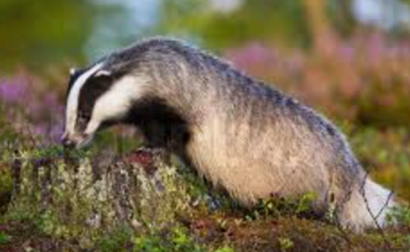
Why you see a badger pop its bottom down on the ground…
Scent plays a pivotal role in group and territory maintenance. Valuable tools in the act of scent-marking are the subcaudal gland (SCG), which is close to the anus, and the paired scent glands located just inside the anus—anecdotal observations suggest that scent glands between the toes (i.e. interdigital glands) may also be used when marking objects, such as trees, near the sett.
Arguably, the most important scent-marking tool is the subcaudal gland, which is used to mark objects in the territory and other members of the clan, which is a process known as allomarking.
The SCG comprises a pouch, the subcaudal pouch (SCP), that’s divided into two sections by a membrane. Several layers of sebaceous glands line the SCP, and these glands secrete an oily lubricant onto the skin and hair, as do apocrine gland cells. It opens to a horizontal slit, two to eight centimetres (about 1-3 in.) wide, between the base of the tail and the anus. The gland secretion is predominantly a composition of unsaturated fatty acids and water, with the consistency of a margarine-like paste. The bacteria partly generated the secretion’s odour in the pouch. Each fatty acid has its own characteristic smell. Chemical analysis of the SCP has shown that the bacterial component and fatty acid composition vary from badger to badger, suggesting each individual has its own unique scent.
What activity occupies them during this season?
Through winter, badgers are a lot less active. Badgers do not truly hibernate, but may enter a state of torpor during freezing or snowy periods. During torpor, the badgers will remain in the sett, often for periods of several weeks, and metabolise fat reserves accumulated during the summer and autumn.
There is usually a marked decrease in a badger’s body temperature during the winter and early spring, being between 2C and 9C (3.6-16.2F) lower from November to April than it is from May onwards. This decrease in body temperature allows for greater “fuel economy,” prolonging their fat reserves when food is scarce or buried under snow.
During periods of exceptionally cold weather, badgers will often use a latrine inside the sett, rather than venturing outside. Though foraging activity fluctuates unpredictably during winter, badgers may forage, even in the snow.
Badgers–Scent Glands (Badger Article 2)


 The Anipal Times
Ooh how interesting to learn
LikeLike
thank you Bob
LikeLike