Paws to That, Callie Cat!

I’m Callie Cat, and we need to discuss what you humans call a ‘water bowl.’ Every morning, you plunk it down with that self-satisfied grin.

‘Fresh water, Callie!’ you chirp. You think because it’s clear and wet, it’s acceptable? Please. By 10:00 AM, that bowl isn’t a drink; it’s a stagnant pond of despair. I lean in, whiskers twitching. It’s a gamble every time. If the water level drops even a millimeter below the rim—just a fraction of an inch—the bowl is officially ‘empty.’ I will sit next to it and scream the song of my people until you rectify this injustice. You look at the bowl and see 95% capacity; I look at it and see a desert wasteland.

Also, if the bowl is too narrow, my whiskers scrape the sides. But if you really loved me, you’d leave a half-full glass of ice water on the in the bowl. That’s the premium stuff.

Now, be a dear and top it off. I can see a microscopic hair floating near the left edge, and frankly, I am disgusted.
Goldie

Goldie, a Golden Retriever, was having a regular visit at the vet. The checkup was mostly fine, but when Dr. Sarah looked at her clipboard, she sighed.

“She’s getting a little heavy,” she said to Goldie’s owner. “No more table scraps, perhaps reduce the… what do you call them? The drive-thru pup cups?”

Goldie gasped. She sat up, her ears alert. Wait. She placed a heavy paw on Dr. Sarah’s knee, looked at her, and barked, “Why?“

Dr. Sarah explained, “Pup cups, while delicious, are just high-fat whipped cream. Think of them as a very rare treat, not a daily requirement.”

She patted her head. Goldie looked at her owner, her expression full of disappointment.

Dr. Sarah explained, “If you consume it with restraint, it’s fine. Perhaps, as a treat, once every few weeks. It shouldn’t become a habit with every coffee shop visit.”

Goldie let out a long sigh, dropping her chin onto her paws.

On the way home, her owner drove past the local café. The barista extended a small pup cup from the car window upon its halt. Goldie felt shocked. She glanced toward her owner, then towards the barista.

She quickly devoured the treat in three seconds, whipped cream covering her nose. It was worth the, well, moderation.

She sat wagging her tail, already planning her next, very “moderate” visit to the vet. 

Walking in the Cold

Hello! Dis is Bart! We are TJ and Bart, and we are ready with a new article for the Anipal Times!

Dis is TJ! We take our duties as writers seriously. And we have a vewy important topic today. Walking in da cold.

Bart: Dat’s wight, TJ. Now we live in Florida, so it does not get too cold here too often. But sometimes it does.

TJ: Dis also for our pals who really have to go through da cold so much during the winter. Dey have real winters. Dis is an important topic!

Bart: Dis is also weally for our humans. Because dey walk us, after all.

TJ: And they don’t walk us any differently than! Man, it is cold outside! Why do they go so slowly?

Bart: Dis is so twue! You know we are low to the gwound! Our pwivate parts are touching the gwass!

TJ: Sowwy if that is too stwong for da readers out there, but dis is an important issue for us doggos! Humans, get da lead out!

Bart: You don’t want to be out dere, wight? Well, we don’t want to be out dere either!

TJ: And yoooose humans are supposed to be da smart ones. If we go inside, then we will all get warm! What is so hard about dat?

Bart: But we also have to have patience with our humans.

TJ: It’s difficult sometimes, though, Bart. Cats have it so good! They can go in da stinky box inside!

Bart: And then da humans clean it. Cats are lucky!

TJ: In da meantime, humans, understand! Faster walks, and less time outside when it is cold!

Bart: Dat’s wight!

TJ: Dis concludes our article. We hope dis helps!

Barnaby the Beagle

Barnaby the beagle wasn’t a fan of freezing weather. The world outside the kitchen window had traded its cheerful autumn colors for white and grey. He was a hound of the field, chasing scents across sunny meadows, not shivering his paws off in the icy air.

This morning, the frosty glass looked cold. Barnaby sighed, a huff that ruffled the fleece throw he was lying on. Barnaby needed to go outside and was gently but firmly guided into his little blue coat with a hood he hated. His human pulled on his leash for him to come along. This morning, the frosty glass looked cold.

Outside, the snow was deeper than his legs were long. He plunged his nose into it, expecting the familiar scent of rabbits. It smelled only of clean, sharp ice.

Then, an unfamiliar scent drifted on the wind. Faint but distinct. It cut through the cold with a warm, sugary hint of something delicious. Barnaby’s ears perked up with the usual droop replaced with focused attention. He followed the trail, his little legs working hard, nose to the ground.

He led his human on a winding path to the edge of the local park, right up to a snow-covered picnic table. There, half-buried in the snow, was a bright red mitten. Tucked inside the mitten was a small, foil-wrapped chocolate bar, likely forgotten by a visitor.

Barnaby nudged the find with his nose, let out a satisfied “A-roo,” then looked up at his human with shining eyes. Freezing weather, he decided, might have its charms after all. Especially if it involved hidden treasure.

Badgers–Scent Glands (Badger Article 2)

Badgers 2 article

Why you see a badger pop its bottom down on the ground…

Scent plays a pivotal role in group and territory maintenance. Valuable tools in the act of scent-marking are the subcaudal gland (SCG), which is close to the anus, and the paired scent glands located just inside the anus—anecdotal observations suggest that scent glands between the toes (i.e. interdigital glands) may also be used when marking objects, such as trees, near the sett.

Arguably, the most important scent-marking tool is the subcaudal gland, which is used to mark objects in the territory and other members of the clan, which is a process known as allomarking.

The SCG comprises a pouch, the subcaudal pouch (SCP), that’s divided into two sections by a membrane. Several layers of sebaceous glands line the SCP, and these glands secrete an oily lubricant onto the skin and hair, as do apocrine gland cells. It opens to a horizontal slit, two to eight centimetres (about 1-3 in.) wide, between the base of the tail and the anus. The gland secretion is predominantly a composition of unsaturated fatty acids and water, with the consistency of a margarine-like paste. The bacteria partly generated the secretion’s odour in the pouch. Each fatty acid has its own characteristic smell. Chemical analysis of the SCP has shown that the bacterial component and fatty acid composition vary from badger to badger, suggesting each individual has its own unique scent.

What activity occupies them during this season?

Through winter, badgers are a lot less active. Badgers do not truly hibernate, but may enter a state of torpor during freezing or snowy periods. During torpor, the badgers will remain in the sett, often for periods of several weeks, and metabolise fat reserves accumulated during the summer and autumn.

There is usually a marked decrease in a badger’s body temperature during the winter and early spring, being between 2C and 9C (3.6-16.2F) lower from November to April than it is from May onwards. This decrease in body temperature allows for greater “fuel economy,” prolonging their fat reserves when food is scarce or buried under snow. 

During periods of exceptionally cold weather, badgers will often use a latrine inside the sett, rather than venturing outside. Though foraging activity fluctuates unpredictably during winter, badgers may forage, even in the snow.

Badgers in Winter…(Badger Article 3)

Badgers article 3 Picture2

Badgers slow down so much that they can happily go into a deep sleep for days or even weeks during times of harsh weather. This sleep state, torpor, requires a significant sound for awakening, unlike hibernation’s deeper state.

Badgers build up reserves of fat during the autumn when there is plenty of food to eat. Fallen fruit, nuts, plus berries, combined with insects, worms, plus carrion, supply badger body fats to slumber for weeks, thus there’s zero worry for waking to eat. Badgers experience winter lethargy during this time period. As they rest, their bodies continue to function by using the energy in those fat reserves.

The UK experienced a mild autumn; thus, the badgers could fatten for winter. Our visiting badgers have been coming every night through December still. Following a dry summer, badgers require nourishment and hydration to survive the winter.

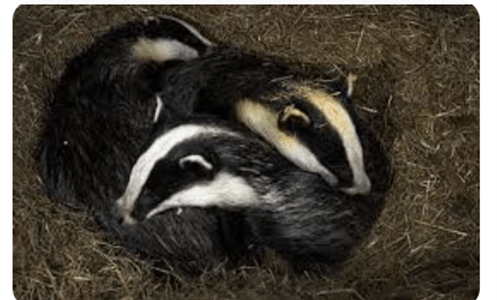
Whole family groups of badgers can make themselves comfortable deep underground in their sett, which provides shelter from rain and protection from extremely cold conditions. They collect bedding materials such as dry grass and fallen leaves to wrap themselves in.

During periods of exceptionally cold weather, badgers will often use a latrine inside the sett, rather than venturing outside. Foraging may occur even in snow, though winter activity fluctuates unpredictably.

Badger article 3 Picture3

Why Animal Testing is Illogical

Animal testing is illogical. Although humans and many other species have similar DNA, and though most organ systems are similar, subtle differences make using animal models to test food, drugs and cosmetics unreliable. Here are just three ways animals don’t react the same as humans.

Rats are known to be more resistant to a certain mushroom toxin than humans. Some mushrooms, notably the Fools webcap, contain a nephrotoxin called orellanine. Rats can eat mushrooms that are deadly to humans.
Feeding a food to animals is not a valid test.

In 2006 a new immune system boosting drug, TGN1412, which had been successfully tested in animals, went to human trials. The subjects were only given the equivalent of 1/500th the safe dose for “non-human primates,” macaques. A single amino acid difference between macaque and human DNA caused violent immune system reactions in humans. Within 90 minutes of the injection, the test subjects suffered searing pain. Within a few hours they suffered multiple organ failure. On a positive note, all the test subjects survived.
Giving a drug to animals is not a valid test.

Dogs and cats don’t usually get poison ivy. Most humans are highly allergic to the active ingredient, urushiol oil. Non-primate species can walk through poison ivy and at most get some irritation.
Applying cosmetics to an animal’s skin is not a valid test.

Fortunately, modern medicine has a number of alternatives to animal tests. One promising technology is Organ Chips, tiny devices about the size of a USB memory stick that contain living human cells.

Lots of drugs don’t make it through the animal trials, but who knows whether the drug companies have thrown away the Magic Bullet simply because it didn’t work on animals?