Weather Article 2

Northern Blocking in the UK

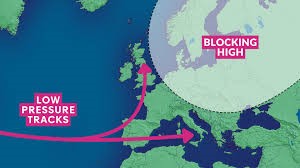
Northern blocking is one of the most influential drivers of UK weather. High pressure building interrupts the jet stream’s usual westward flow in the high latitudes of Greenland, Iceland, or Scandinavia. This “block” forces weather systems to divert around it, often locking the UK into a particular pattern for days or even weeks.

Although blocking can occur at any time of year, its effects in winter and spring are dramatically different.

For snow lovers like mummy, northern blocking is a key hope for winter months in the UK and to be in the correct position to bring in winds and snow. 

Northerly flows bring snow showers to Scotland, Northern Ireland, and the eastern coasts.

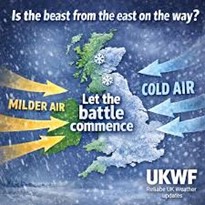
Easterly flows can produce widespread snow, especially when North Sea convection is strong. People know this weather phenomenon as the Beast from the East.

How winter blocking forms

In winter, the jet stream is stronger and more active. When a northern block forms, it forces the jet to buckle southwards, often sending it through Spain or the Mediterranean. This opens the door for Arctic or continental air to spill into the UK.

The most common winter blocking positions are:

*Greenland High (Greenland block) drives cold north‑westerlies or northerlies into the UK.
*The Scandinavian High (Scandi block) pulls in cold easterlies from Siberia and western Russia.
*Energy demand spikes. Prolonged cold spells increase heating demand and can strain infrastructure.

Why winter blocking is so impactful

Cold air masses are dense and persistent. Once they settle over the UK, they can be very difficult to shift without a major change in the jet stream. That’s why winter blocking often leads to memorable cold spells—think 2010 or the “Beast from the East” in 2018.

Northern Blocking in Spring:

Spring is a transitional season, and blocking behaves differently because the atmosphere is warming, the jet stream weakens, and the contrast between polar and tropical air reduces.

How spring blocking forms

Spring blocks often develop over:

*Greenland
*Iceland
*Scandinavia
*The North Atlantic

But the key difference is that the air masses involved are no longer cold. Instead, the block’s position determines whether the UK gets warmth, chill, or dry settled weather.

It can bring cold, grey days, though, and chilly spring nights. Can also mean a lot of dry weather, which is not welcome in spring for nature, wildlife, and farmers.

The same blocking pattern that brings snow in February might bring sunshine and warmth in May. The key is the temperature of the source air and the strength of the sun. By late spring, even an easterly flow can feel pleasant rather than bitter.

Badger Article 4

Badgers in Spring…..

Badgers are very active in spring after keeping warm and conserving energy throughout winter.

February marks prime cub birth season within the UK. A litter normally has 1-5 cubs, and they will remain tucked up in the sett, feeding from their mum. They will stay underground for a few months.

February and March are key mating times. Badgers use delayed implantation to ensure cubs are born between January and March. While mating can occur 11 months prior, actual gestation is only 6-8 weeks, as fertilized embryos (blastocysts) remain dormant in the uterus until early winter. 

February through to May is a very active time for badgers, with them needing food, especially nursing mums.
There can be hierarchical changes and territorial fights.

Regrettably, increased activity presently heightens badger transit and their vulnerability to road fatalities.

Our mummy is a volunteer for our local badger group, and that means the sad role of going out to deceased badgers on our roads to check they are not lactating females. Should that be true, finding the abandoned cubs requires urgent attention to ensure their survival. This is especially relevant to lactating female foxes too at this time of year.

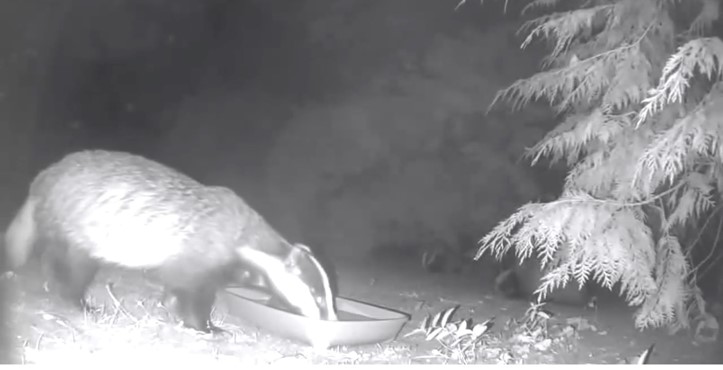
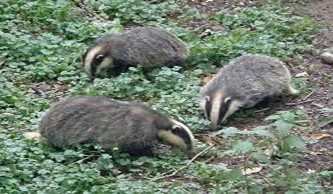
We can see that our visiting mama badger is lactating, so we will hope to see cubs in the forthcoming months

For more information, visit The Badger Trust and Wildlife Trusts

Animal Holidays and Observations, April 5 – April 11

April pet holidays

The April Monthly Observations are:

Heartworm Awareness Month
National Pet First Aid Awareness Month
Prevention of Cruelty to Animals Month
Canine Fitness Month
Prevent Lyme Disease in Dogs Month
National Adopt a Greyhound Month

The daily Holidays/Observations during the week of April 5 – April 11 are:

• April 5: Every Day is Tag Day
• April 6: National Siamese Cat Day
• April 7: National Pet Health Insurance Day
• April 8: National Dog Fighting Awareness Day
• April 8: Catahoula Leopard Dog Day
• April 10: National Hug Your Dog Day
• April 11: National Pet Day
• April 11: Dog Therapy Appreciation Day

Animal Holidays and Observations, March 29 – April 4

April pet holidays

The April Monthly Observations are:

Heartworm Awareness Month
National Pet First Aid Awareness Month
Prevention of Cruelty to Animals Month
Canine Fitness Month
Prevent Lyme Disease in Dogs Month
National Adopt a Greyhound Month

The daily Holidays/Observations during the week of March 29 – April 4 are:

• April 1-7: International Pooper Scooper Week
• April 1: International Bull Terrier Day
• April 2: National Ferret Day
• April 4: World Stray Animals Day
• April 4: World Rat Day

Dancing in the Dark

Guest Post–Angel Alma

Friday the 16th of January was a special day in Lapland. For the first time in roughly six weeks, dawn broke. It peeked above the horizon at 12:02 p.m. and disappeared at 12:43 p.m. This happened in Utsjoki, in the northernmost part of Finland.

Winter nights are long in other parts of our country too. It’s not totally dark all the time, as the polar night season, which we call “kaamos,” is also bluish and in the south even light—during the few daylight hours.

This remarkable season offers moonlight, stars on clear nights, and the captivating auroras. Aurora Borealis, the northern lights, gives a display worth watching.

People in ancient times had various explanations for the magical glowing green, blue, yellow, and red lights which filled the sky, dancing, waving, and flickering.

Many folklore stories connect auroras with blood or dead human souls. People also saw them as signs of something big happening. In Finland they are called “Revontulet”, “repo” being an old name for a fox. “Tulet” means fires. So Firefoxes were running through the sky, swishing their tails, red sides touching trees and snow.

Scientists have been interested in auroras since early days, trying to explain their origin. Nowadays we know solar winds interacting with Earth’s magnetosphere cause them. Scientists still eagerly study them, and more secrets remain to be discovered.

No wonder auroras are one of the most admired tourist attractions in Lapland. Finland itself provides excellent observation locations, due to its northern location. It’s also more or less inhabited even in the remote areas. You can see auroras even in April, before it becomes too light.

Mun saw her first Auroras in Helsinki in the 1990s on New Year’s Eve. She went outside with friends during a party at midnight to wish each other a Happy New Year. Green lights were waving up in the sky, like silent fireworks.

For hunting Auroras, you have modern equipment to help. Just check one of the several Aurora alert apps on the phone or a meteorological site. Choose a wide, open place facing north, without too many city lights. Mum used to drive to the nearest fields, but lakesides are also good for spotting.

Aurora hunting is not always a success. Mum drove toward country regions for approximately thirty minutes during the nighttime, solely to observe stellar displays against the dark heavens. Driving back and going to sleep.

Sometimes Mum can see them behind the house, even from her bedroom window. If it’s too cold or too late, she stays in bed dreaming of firefoxes running over the dark winter sky, swishing their tails.

You can find more information about Auroras in Finland, for instance, on these internet sites:
Ursa Astronomical Association, Finnish Meteorological Institute, visitrovaniemi.fi and visitfinland.com 

Weather Article 1

Weather article 1 Picture1

#Weathercat:

My mummy and I both love the weather. She maintained a weather diary using paper for many years during her youth; now, our garden features a weather station we’ve had for quite some time. She finds it so interesting, exciting, and scary.

The UK’s weather feels the impact of its island status plus its geographical position. We are Atlantic driven but depending on the weather pattern setup and position of the jet stream, we can bring in weather from other directions.

Jet steam:

The jet stream is a high-altitude river of wind (5-7 miles up) that steers UK weather, blowing west-to-east, with its position dictating whether the UK gets mild, wet Atlantic weather (when it’s south of the UK) or colder, drier spells (when it’s further north). A fast, straight jet stream brings unsettled, stormy conditions by pulling low-pressure systems towards the UK, while a weaker, buckled jet stream can lead to blocked high-pressure systems, causing longer periods of stable, dry, or even cold weather, depending on the air masses involved. 

When we have a southerly wind in the summer, we have experienced dust storms up from the Sahara. A few years ago, when working in London, the entire city seemed to turn red and there was dust everywhere—it was quite an experience that Mummy loved.

If the winter weather pattern has high pressure blocking, we can then get the Beast from the East, which brings freezing temperatures and snow in from the East.

The cold spell we experienced over Christmas and the start of the year 2026 was driven from the North because of the position of the Scandinavian blocking high pressure. This cold spell has been across Europe, and Lapland has experienced record low temperatures of -42.8c.  Mummy has visited Lapland several times, and the lowest she has experienced is -30c and that was VERY cold.

Do you have a favourite weather? Our mummy’s is snow, she just loves it and finds falling snow and the sparkle and crunch of laying so super special. 

We will delve into some more weather facts and types of weather in future articles. 

Video: The Tigers of Scotland

Narrated by Iain Glen, this independent natural history documentary investigates the Scottish Wildcat, their endangered status and the conservation efforts being undertaken to prevent their extinction.

Scottish Wildcats are affectionately known as Highland Tigers. The name originates from their striped fur and that they’re not only one of Britain’s largest predators, but the UK’s only “big cat”.

Originally released on Netflix in 2018, this is the first time the full length, unedited version has been published, and in 4K.

Badgers–Scent Glands (Badger Article 2)

Badgers 2 article

Why you see a badger pop its bottom down on the ground…

Scent plays a pivotal role in group and territory maintenance. Valuable tools in the act of scent-marking are the subcaudal gland (SCG), which is close to the anus, and the paired scent glands located just inside the anus—anecdotal observations suggest that scent glands between the toes (i.e. interdigital glands) may also be used when marking objects, such as trees, near the sett.

Arguably, the most important scent-marking tool is the subcaudal gland, which is used to mark objects in the territory and other members of the clan, which is a process known as allomarking.

The SCG comprises a pouch, the subcaudal pouch (SCP), that’s divided into two sections by a membrane. Several layers of sebaceous glands line the SCP, and these glands secrete an oily lubricant onto the skin and hair, as do apocrine gland cells. It opens to a horizontal slit, two to eight centimetres (about 1-3 in.) wide, between the base of the tail and the anus. The gland secretion is predominantly a composition of unsaturated fatty acids and water, with the consistency of a margarine-like paste. The bacteria partly generated the secretion’s odour in the pouch. Each fatty acid has its own characteristic smell. Chemical analysis of the SCP has shown that the bacterial component and fatty acid composition vary from badger to badger, suggesting each individual has its own unique scent.

What activity occupies them during this season?

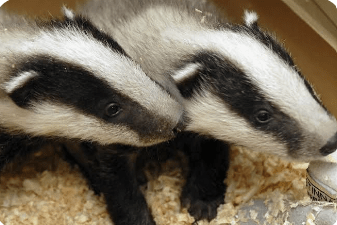
Through winter, badgers are a lot less active. Badgers do not truly hibernate, but may enter a state of torpor during freezing or snowy periods. During torpor, the badgers will remain in the sett, often for periods of several weeks, and metabolise fat reserves accumulated during the summer and autumn.

There is usually a marked decrease in a badger’s body temperature during the winter and early spring, being between 2C and 9C (3.6-16.2F) lower from November to April than it is from May onwards. This decrease in body temperature allows for greater “fuel economy,” prolonging their fat reserves when food is scarce or buried under snow. 

During periods of exceptionally cold weather, badgers will often use a latrine inside the sett, rather than venturing outside. Though foraging activity fluctuates unpredictably during winter, badgers may forage, even in the snow.

Badgers in Winter…(Badger Article 3)

Badgers article 3 Picture2

Badgers slow down so much that they can happily go into a deep sleep for days or even weeks during times of harsh weather. This sleep state, torpor, requires a significant sound for awakening, unlike hibernation’s deeper state.

Badgers build up reserves of fat during the autumn when there is plenty of food to eat. Fallen fruit, nuts, plus berries, combined with insects, worms, plus carrion, supply badger body fats to slumber for weeks, thus there’s zero worry for waking to eat. Badgers experience winter lethargy during this time period. As they rest, their bodies continue to function by using the energy in those fat reserves.

The UK experienced a mild autumn; thus, the badgers could fatten for winter. Our visiting badgers have been coming every night through December still. Following a dry summer, badgers require nourishment and hydration to survive the winter.

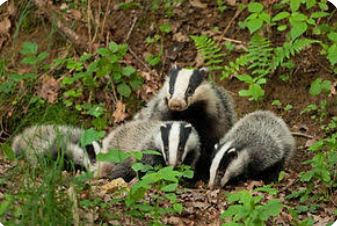
Whole family groups of badgers can make themselves comfortable deep underground in their sett, which provides shelter from rain and protection from extremely cold conditions. They collect bedding materials such as dry grass and fallen leaves to wrap themselves in.

During periods of exceptionally cold weather, badgers will often use a latrine inside the sett, rather than venturing outside. Foraging may occur even in snow, though winter activity fluctuates unpredictably.

Badger article 3 Picture3

Why Animal Testing is Illogical

Animal testing is illogical. Although humans and many other species have similar DNA, and though most organ systems are similar, subtle differences make using animal models to test food, drugs and cosmetics unreliable. Here are just three ways animals don’t react the same as humans.

Rats are known to be more resistant to a certain mushroom toxin than humans. Some mushrooms, notably the Fools webcap, contain a nephrotoxin called orellanine. Rats can eat mushrooms that are deadly to humans.
Feeding a food to animals is not a valid test.

In 2006 a new immune system boosting drug, TGN1412, which had been successfully tested in animals, went to human trials. The subjects were only given the equivalent of 1/500th the safe dose for “non-human primates,” macaques. A single amino acid difference between macaque and human DNA caused violent immune system reactions in humans. Within 90 minutes of the injection, the test subjects suffered searing pain. Within a few hours they suffered multiple organ failure. On a positive note, all the test subjects survived.
Giving a drug to animals is not a valid test.

Dogs and cats don’t usually get poison ivy. Most humans are highly allergic to the active ingredient, urushiol oil. Non-primate species can walk through poison ivy and at most get some irritation.
Applying cosmetics to an animal’s skin is not a valid test.

Fortunately, modern medicine has a number of alternatives to animal tests. One promising technology is Organ Chips, tiny devices about the size of a USB memory stick that contain living human cells.

Lots of drugs don’t make it through the animal trials, but who knows whether the drug companies have thrown away the Magic Bullet simply because it didn’t work on animals?