How A Cat Shows Their Love, Part 2

Cooper

Shy felines display affection in numerous subtle, endearing ways. Shy cats may not be loud or cuddly, but their affection is gentle and deeply trusting. Willow and I were shy cats, especially with strangers.

  1. Shy cats make small, polite requests for attention. They may do this by a quiet meow, sitting near you, or leaning towards your hand. I used to enjoy standing next to Daddy, and he would stand with me. Willow used to make little meows, but she only gave silent meows at first.
  2. Shy cats rub against objects such as doorways, walls, and furniture when you enter a room to mark the area with their scent to show they belong there. Willow loved to rub against things.
  3. Shy cats sometimes like to do gentle head bumps or nose kisses. It is a big compliment from a shy cat. Willow was an enthusiastic head-bumper.
  4. Shy cats communicate through their tails. With a slow-swishing tail and relaxed posture, the cat shows that it’s comfortable and content. A cat that holds its tail held upright with a small hook at the end is giving a friendly greeting. A cat that has its tail gently wrapped around your leg, or touching your foot or leg, is giving the equivalent of a cat hug. Daddy witnessed that action often. I used to touch his foot or leg with my tail.
  5. Shy cats show that they feel safe with you by quietly following you around the house, being in the same room, or sitting near you (even if not touching). Willow and I would do those things.

    Each shy cat has its own special way of showing its love for you, which is both sweet and subtle. Quietly observing and letting the shy cat approach you on its terms will build the bonds of love

    Cooper

Raphael the Gray Tabby


A gray tabby named Raphael lived in a house during the winter polar vortex. He was a creature of habit, and his most pressing winter habit was finding the precise location of warmth.

One particularly frigid afternoon, Raph discovered a new kitty perch: the top of the heat unit. It wasn’t just warm; it was the warmest spot. As he curled up, a moment occurred: a face-warming trend. To any observer, his face glowed with blissful heat. The external heat source created feline contentment.

His human, James, noticed the trend. He knew this warmth was normal, a sign of comfort and security. But being a diligent cat owner, he also kept a watchful eye.

One evening, James observed a subtle shift. The warmth was present, yet quiet stillness, uncharacteristic of Raph, also existed. He declined his favorite salmon snack and moved with a lethargy that sent a small chill down James’s spine, colder than the winter air outside.

A quick trip to the vet confirmed his suspicions. The face-warming trend, when coupled with a loss of appetite and unusual listlessness, was not just about seeking comfort; it was a fever.

Raph, via medicine plus rest, recovered again, mastering thermal comfort. The face-warming trend returned, but this time, it was a healthy glow of a happy, warm, and well-monitored cat, who knew the difference between a cozy sunbeam and a call for his human’s gentle attention.
,

Feline Infectious Peritonitis (FIP), Part Two

This is the second of a two-part series about FIP treatments.

Until recently, no treatment for FIP was possible, and cats with the disease died within days to weeks. Because of the COVID pandemic, interest in coronaviruses increased, resulting in the development and availability of several antiviral drugs. People commonly use four: GS-441524 and its precursor remdesivir, molnupiravir (Lagevrio), and Paxlovid (nirmatrelvir/ritonavir).

The mainstay of treatment is GS-441524. Its mechanism of action is premature RNA chain termination in the virus, preventing viral replication. Doctors give it by mouth once or twice a day. The dose is 15 mg/kg/day given once daily or 20 mg/kg/day divided into two doses if there is neurological or eye involvement. A kilogram (kg) is 2.2 lbs.

In cats that cannot swallow, the veterinarian can administer remdesivir subcutaneously or the medication can replace the first few IV doses. Remdesivir uses the same doses as GS-441524. The optimal duration of treatment is under investigation, but for now, 84 days (12 weeks) of therapy are standard.

There are ongoing studies investigating shorter treatment (6 weeks); the initial results on a group of twenty cats have been favorable. Medication presents substantial costs, and a twelve-week treatment might prove difficult to finance. Therefore, vets plan to assist owners in shortening treatment when they can.

If a cat is clinically doing well (alert, eating) and the lab results have tended towards normal by four weeks, discontinuing treatment at 6 weeks may be reasonable. Once the treatment ends, the veterinarian should examine the cat within one or two weeks, regardless of how long the therapy lasted.

If your cat’s symptoms come back, schedule an earlier check-up, as relapses may occur after 12 weeks of treatment. Research shows that 80% of cats go into remission following treatment. Table 1 shows key milestones for cats undergoing treatment with GS-441524.

AbnormalityExpected time to resolution
Fever/inappetence2-7 days
Effusions1-2 weeks
Blood count abnormalities2-3 weeks
Elevated bilirubin2-3 weeks
Albumin: globulin > 0.66-10 weeks
Eye and neurologic abnormalitiesImprovement by day 5, resolution within 2 weeks


If cats respond poorly to GS-441524 (failing to reach clinical milestones on time), you can also add Paxlovid. It works differently from GS-441524 and may provide a synergistic effect.

Initially, veterinarians administered Molnupiravir as a rescue drug for cats not responding to GS-441524 (not reaching treatment milestones on time), but recent studies use it as the primary treatment. It works by causing multiple mutations in the replicating virus, resulting in its eradication. The dose is 10-15 mg/kg given twice a day.

Since it’s designed for humans, this dosage form is also impractical and can decrease appetite. As a result, it might be necessary to use appetite stimulants or antiemetics. It causes birth defects in rats and cartilage defects in growing humans. Treated cats exhibit folded ear tips, broken whiskers, and flaky skin.

Cats may also experience muscle wasting and elevation of ALT (Alanine Aminotransferase, present in the liver, muscle, kidneys, and other organs).

Paxlovid (nirmatrelvir/ritonavir) is two drugs in one. Nirmatrelvir inhibits RNA copying enzymes, and ritonavir slows the degradation of nirmatrelvir in the body. Doctors use it along with GS-441524 or molnupiravir if the response is incomplete. You must be careful if the cat is taking medications eliminated by the same pathway, and you may need to adjust their doses.

Supportive measures include appetite stimulants, pain meds and even a feeding tube if the cat is unable or unwilling to take medications by mouth.

With effective treatment for FIP, inappropriate use of the drugs has inevitably occurred. Reports show that whole litters of kittens received treatment because a vet diagnosed one kitten with FIP or even administered preventative treatment.

Though a Feline Enteric Coronavirus (FeCV) vaccine is available, the American Association of Feline Practitioners does not recommend it. You must vaccinate the cat before FeCV infects it, but this is impossible because many kittens contract the infection before they can receive the vaccine at 14 weeks old. Further, immunity wanes with time.

There is currently work ongoing on an effective vaccine.

Finally, a word on the FIV on Cyprus. Reports conflict regarding the prevalence, though FIP is more widespread elsewhere. One source estimates that 30% of the feral cats in Cyprus have died of the disease. Twenty-eight percent of the affected cats have nervous system involvement, compared to 14% of FIP cats elsewhere. The malady infects felines of every age, not merely juvenile ones.

DNA sequencing has shown that the virus responsible is a recombination between the feline and canine coronaviruses.

The alarming property of this virus is that it is transmissible between cats. Folks from the United Kingdom and Europe have adopted feline companions while on holiday in Cyprus. At least one cat like that has developed FIP. It presents a risk regarding worldwide, European spread of the mutant virus.

Footnotes and further reading/listening

  1. Conference Proceedings: Am College Vet Internal Med Forum; ACVIM 2023. Sally J. Coggins
  2. Pedersen, N. et al., J, Feline Med Surg. 2019 Feb 13; 21(4):271-281. Efficacy and Safety of the nucleoside analog GS-441524 for treatment of cats with naturally occurring feline infectious peritonitis.
  3. Coggins, S.J. et al., J Vet Intern Med. 2023 Sep-Oct; 37(5): 1772-1783. Epub 2023 Jul 13. Outcomes of treatment of cats with feline infectious peritonitis using parenterally administered remdesivir, with or without transition to orally administered GS-441524.
  4. Taylor, S., Talk at the International Society for companion Animal Infectious Disease meeting 2024. An Update on Treatment of FIP Using Antiviral Drugs in 2024: Growing Experience but Still More to Learn.
  5. Coggins, S.J., Talk at the American College of Vet Int Med meeting 2023. Updates in Feline Infectious Peritonitis Treatment.
  6. Felten, S. et al., J Feline Med Surg. 2017 Apr; 19(4): 321-335. Detection of feline coronavirus spike gene mutations as a tool to diagnose FIP.
  7. Sorrell, S., Tasker, S., Taylor, S., Barker, E., Gunn-Moore, D.: Feline Infectious Peritonitis (FIP) Information for Cat owners. Stokes Pharmacy website: https://www.stokespharmacy.com/wp-content/uploads/2024/05/Pet-Owner-Brochure-Printable-Version.pdf
  8. Thayer, V. et al., J Feline Med Surg. 2022 Sep; 24(9):905-933. 2022 AAFP/Every Cat Feline Infectious Peritonitis Diagnosis Guidelines.
  9. https://bova.vet/
  10. https://www.stokespharmacy.com/stokes-bova-partner-for-feline-infectious-peritonitis-treatment/
  11. https://www.stokespharmacy.com/fip/cat-owner-resources/
  12. https://bova.vet/fip-resource-page/#FIP-Webinars
  13. https://vcahospitals.com/know-your-pet/feline-infectious-peritonitis
  14. https://veterinarypartner.vin.com/default.aspx?pid=19239&id=11618072
  15. https://www.merckvetmanual.com/cat-owners/disorders-affecting-multiple-body-systems-of-cats/feline-infectious-peritonitis-fip
    16.Merck Veterinary Manual, 11th edition, 2016, pp. 782-790
    17.https://www.wormsandgermsblog.com/tags/feline-infectious-peritonitis/
  16. https://ccah.vetmed.ucdavis.edu/sites/g/files/dgvnsk4586/files/inline-files/Inappropriate%20use%20of%20GS.pdf
  17. https://www.biorxiv.org/content/10.1101/2023.11.08.566182v3.full.pdf . Attipa, C., Warr, A. et al. BioRxiv preprint 3 Sep 2024: Emergence and spread of feline infectious peritonitis due to a highly pathogenic canine/feline recombinant coronavirus.
  18. https://thewebinarvet.com/videos/what-you-should-know-about-fcov-23-and-the-outbreak-of-fip-in-cyprus
  19. Gao, Y. et al: Virus Research V 326, March 2023: An updated review of feline coronavirus: mind the two biotypes

Why You Should Consider Adopting An Older Cat

Smokey

I am loving, affectionate, and I need a home.

While kittens are small, cute, and full of fun, there is a group of cats that often gets overlooked at shelters–older cats. Cats like me, and other older cats, have lots of love to give and may be a better choice for your home.

When adopting an older cat, you will save a life. Older cats are often the last to be adopted and the first to be euthanised. The satisfaction of giving an older cat a home is a wonderful feeling. My mummy feels immense gratitude for providing a home for me after an extended period of my lacking one.

Older cats are thankful that someone gave them a home for their senior years. They make loyal and loving companions. I love my mummy, who has given me a home of my own.

Kittens need a lot of supervision as they are curious and mischievous. Older cats are more sensible and relaxed, but still enjoy some playtime. They like the simple pleasures of a warm lap, sun puddles, and a quiet place to nap. Strictly speaking, I am not an older cat, being only four years and seven months old, but I can be naughty and silly.

Since older cats have developed personalities, you know what you are getting. Whether you are looking for a lap cat or an independent companion, you can find the perfect fit for your home.

While many people are concerned about medical costs for older cats, shelters will provide medical histories. Some cats require medication, and others may be in excellent health, but you will know in advance. With kittens, their future health is unknown. I had some minor health complaints, but I am in excellent health now.

In conclusion, when you choose to adopt an older cat, you change your life and gain a loyal and loving friend. Older cats deserve a loving, forever home, too. Contact your local animal shelters or rescue organisations to find your new family member. You won’t regret it.

The Cat Who Ate the Sun

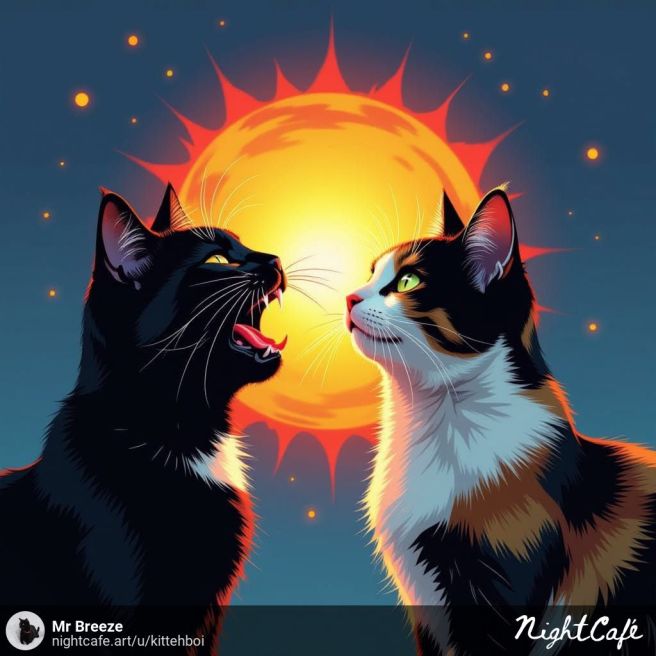
The Cat that ate the Sun
The Cat who ate the sun.
by @kittehboi & Nightcafe Studio.

“The Cat Who Ate the Sun” is a mythical story explaining the origin of tortoiseshell cats.  According to the legend, the sun became a black cat to visit the Earth. When the sun left, it left behind its fire in the patches of red and orange in the torties’s coat.

This is why Tortoiseshell cats are so popular, because they seem to carry a spark of the sun itself.

Furry Napping Feline

Great fluffy lump
warm fed feline
curled sleeping
all sleek fur
shiny whiskers
and casual stretch
a yawn now
becomes
furry python
with gleaming
talons o’ death

Momentary shadow passes
eyes flash open
fangs snap wetly
brisk tail lashes

Somewhere…prey!

Maybe not
and the great hunter rolls over
again to nap and not
P.A.W.

How A Cat Shows Their Love, Part 1

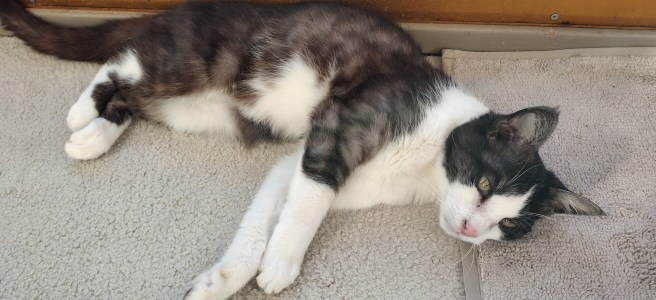
Willow pic 1

Cats are not the cold, independent creatures that some people believe them to be. We have much love to give to our chosen human companions. Sometimes, the unobservant human misses how we show our love.

  1. When a cat blinks at you slowly, it is the equivalent of a ‘kitty kiss’. Some of us choose to show our love this way. It means that we trust you completely.
  2. When a cat purrs while sitting next to you or on you, it mostly means that it is happy, content and relaxed. Cooper, my brofur, had a powerful purr engine and purred his heart out when he was next to Mummy or Daddy.
  3. When a cat sleeps near you, it shows love, trust and that it feels safe with you. Cooper loved to take a nap curled up in Mummy’s arms, and he slept at night at her feet.
  4. When a cat walks around with its tail held upright, especially with a curl at the tip, it says that it is pleased to see you. I loved doing that.
  5. When a cat bumps or rubs you with its head, it shows affection and marks you with its scent. I loved to rub my face on my Mummy’s or Daddy’s shoes and legs. I was very enthusiastic about it.
  6. When a cat shows its belly by lying on its back near you, it shows total trust in you. That’s because it is the most vulnerable area of their bodies. Cooper also delighted in doing that. Some cats don’t like their bellies touched, though I don’t mind it.

    As you can see, cats show their love with their body language and/or speech. Part two will cover several ways feline companions display affection.
Willow pic 2
Willow pic 2

Willow

Caturday Confessions from Trickle & Matilda!

It’s time for Caturday Confessions!

Kittens Trickle and Matilda, one of our columnist pairs, will now share a wonderful confession!

Today, we, Matilda and Trickle, are proud to announce we’ve ruined our reputation as model kittens! At 6 months old, we thought we should do some grown-up cat stuff.

M: So I, Matilda, caught a mouse! Such fun after I’d been trying for ages. While She and He were out, I brought it into the house!

T: I helped!

M: You did not. I let you play with it, but what I wanted you to do was take it into Her bedroom and leave a mess of fur everywhere. I had to do that myself. Honestly!

T: Well, there was a huge, glorious mess, anyway. And it isn’t my fault that She came and found us when YOU had the mouse in your mouth and ran under the bed, is it?

M: sniggers She didn’t like that at all, heehee! That’s why I gave you the mouse, so she’d see you with it and think…

T: What, think I’d caught it? Is that why She chased me down the hall? But I hid in our tunnel and growled at Her when She tried to take it off me!

M: Um…well…yes, I thought of letting you take the blame. I never thought you would allow Her to take the mouse off you that easily!

T: She shouted at me!

M: You’re a wimp. A big wuss!

T: Am not. Anyway, it was all a lot of fun, wasn’t it?!

M: It was! My first mouse and the first real telling off we received. I think we can say we’ve grown up today.

T: I think so too. High paw! Hey, you don’t think we annoyed her so much that she won’t give us any supper?

Feline Infectious Peritonitis (FIP)

This is the first of a two-part series about FIP.
Part one outlines what FIP is and several methods used for a possible diagnosis.

FIP is a viral disease of cats that was almost uniformly lethal until recently. A recently discovered effective treatment is now available to veterinarians in the United States, Canada, Australia, Japan, and most of Europe.

The virus responsible for FIP is Feline Infectious Peritonitis Virus (FIPV), which is a mutated form of Feline Enteric Coronavirus (FeCV). FIPV is an RNA virus, so it encodes its genetic information in RNA instead of in DNA. It is a common misconception that FeCV is the same virus responsible for causing COVID in humans. The SARS-CoV-2 virus, while also a coronavirus, differs from FeCV, which does not cause COVID.

The current consensus is that dogs and cats do not develop disease from infection with SARS-CoV-2 and do not transmit infection to other animals or people.

FeCV is commonly present in the digestive tract of cats. Infection is typically asymptomatic or causes several days of diarrhea or mild upper respiratory symptoms, like sneezing and congestion. The virus spreads through feces, saliva, and possibly sneezing. Cats that share litter boxes and groom each other are at risk of being infected, which is why infection is more common in multi-cat households, shelters, catteries, and pet stores. In these situations, the FeCV infection affects 74-100% of cats.

In 5-12% of FeCV cases, the virus mutates into a form that can leave the intestine and infect white blood cells. This type is known as the Feline Infectious Peritonitis Virus (FIPV). 3-10% of cats infected with FIPV develop FIP. It is still unclear why only some cats are affected.

In a newly diagnosed cat with FIP, there is often a history of a stressful event (e.g., re-homing, relocation, or new household member, surgery, or corticosteroid use weeks before illness onset. The disease affects 0.3-1.4% of cats worldwide.

FIP can also affect African lions, mountain lions, leopards, cheetahs, jaguars, lynx, servals, caracals, European wildcats, sand cats, Pallas’ cats, and almost all other large cats.

In cats affected by FIP, the virus causes an intense inflammatory reaction in blood vessels, where infected cells typically settle in the abdomen, kidney, or brain, but they may also settle anywhere.

The disease takes two forms: the “wet” (effusive) form is acute, and the “dry” (non-effusive) form is more slowly progressive, though the two types often overlap. Some experts question the usefulness of classifying the disease as wet or dry. The dry form may progress to the wet form.

In the wet form, reactive fluid leaks out of damaged blood vessels, causing effusions inside body cavities such as the abdomen (peritoneal effusion) with increased abdominal girth. Effusion in the chest cavity (pleural effusion) or around the heart (pericardial effusion) can cause difficulty breathing, and muffled breath or heart sounds.

In rare cases, effusion involves the scrotum. Inflammation in the abdomen may cause organs to adhere and cause a palpable mass. Common symptoms also include lethargy, loss of appetite, and weight loss (or failure to thrive in a kitten), and a fluctuating fever.

Cats may also present with jaundice, enlarged lymph nodes, and lameness because of tissue involvement surrounding the joints. A vet may observe fluffy-looking white plaques along blood vessels, which are white cell accumulations on a retinal exam, which is less common than in the dry form.

Multiple areas of white cell accumulation in various organs, including the kidney, liver, intestine, brain, and eyes, characterize dry or non-effusive FIP. Abdominal organs and lymph nodes may also become enlarged. Involvement of the intestine may cause palpable thickening, vomiting, diarrhea, or constipation. There may be intermittent fever. Eye involvement may be the only abnormality seen.

Each of the above signs is not unique to FIP. You must also consider other diseases, including septic peritonitis or pleuritis (a bacterial infection inside the peritoneal or pleural sac), cancer, such as lymphoma or histiocytic sarcoma, infection with Toxoplasma, Bartonella or mycobacteria, pancreatitis, primary myocarditis, congestive heart failure, primary Immune Mediated Hemolytic Anemia, and primary liver disease.

There is currently no single test for FIP. In a laboratory investigation, white blood cells may be high and red blood cells low. A high serum protein is frequent, but the albumin is low. The serum protein elevation is due to high gamma globulins. This results in an abnormal albumin to globulin (A:G) ratio. Normally, there is more albumin than gamma globulin in the blood. (A:G is greater than 1).

This ratio often inverts to FIP (both wet and dry), and it aids in diagnosis. An A:G ratio of less than 0.4 makes FIP more likely, while a ratio of over 0.8 makes it less likely. High bilirubin (the yellow pigment in jaundice) and jaundice itself are common, as are mild elevations in transaminases (“liver enzymes”). BUN (Blood Urea Nitrogen) might be high. The Rivalta test, a bedside test on the fluid obtained from an effusion, is positive. AGP (alpha-1-acid glycoprotein) is sensitive and specific for FIP; FIP is if AGP is over 1000 mg/dL.

A low titer of anti-coronavirus antibodies might not be useful in the diagnosis because the body could use the antibodies to fight the infection.

The “gold standard” of FIP diagnosis is immunocytochemistry on effusion fluid or immunohistochemistry on tissue obtained by biopsy. In this test, they stain cells or tissue with fluorescent dye attached to an anti-FIPV antibody and then wash away the excess antibody. Antibody uptake causes affected cells to fluoresce, which confirms the FIP diagnosis. Unfortunately, these are invasive tests that are not always possible to perform on a sick kitten.

Footnotes and further reading/listening

  1. Conference Proceedings: Am College Vet Internal Med Forum; ACVIM 2023. Sally J. Coggins
  2. Pedersen, N. et al., J, Feline Med Surg. 2019 Feb 13; 21(4):271-281. Efficacy and Safety of the nucleoside analog GS-441524 for treatment of cats with naturally occurring feline infectious peritonitis.
  3. Coggins, S.J. et al., J Vet Intern Med. 2023 Sep-Oct; 37(5): 1772-1783. Epub 2023 Jul 13. Outcomes of treatment of cats with feline infectious peritonitis using parenterally administered remdesivir, with or without transition to orally administered GS-441524.
  4. Taylor, S., Talk at the International Society for Companion Animal Infectious Disease meeting 2024. An Update on Treatment of FIP Using Antiviral Drugs in 2024: Growing Experience but Still More to Learn.
  5. Coggins, S.J., Talk at the American College of Vet Int Med meeting 2023. Updates in Feline Infectious Peritonitis Treatment.
  6. Felten, S. et al., J Feline Med Surg. 2017 Apr; 19(4): 321-335. Detection of feline coronavirus spike gene mutations as a tool to diagnose FIP.
  7. Sorrell, S., Tasker, S., Taylor, S., Barker, E., Gunn-Moore, D.: Feline Infectious Peritonitis (FIP) Information for Cat owners. Stokes Pharmacy website: https://www.stokespharmacy.com/wp-content/uploads/2024/05/Pet-Owner-Brochure-Printable-Version.pdf
  8. Thayer, V. et al., J Feline Med Surg. 2022 Sep; 24(9):905-933. 2022 AAFP/EveryCat Feline Infectious Peritonitis Diagnosis Guidelines.
  9. https://bova.vet/
  10. https://www.stokespharmacy.com/stokes-bova-partner-for-feline-infectious-peritonitis-treatment/
  11. https://www.stokespharmacy.com/fip/cat-owner-resources/
  12. https://bova.vet/fip-resource-page/#FIP-Webinars
  13. https://vcahospitals.com/know-your-pet/feline-infectious-peritonitis
  14. https://veterinarypartner.vin.com/default.aspx?pid=19239&id=11618072
  15. https://www.merckvetmanual.com/cat-owners/disorders-affecting-multiple-body-systems-of-cats/feline-infectious-peritonitis-fip
    16.Merck Veterinary Manual, 11th edition, 2016, pp. 782-790
    17.https://www.wormsandgermsblog.com/tags/feline-infectious-peritonitis/
  16. https://ccah.vetmed.ucdavis.edu/sites/g/files/dgvnsk4586/files/inline-files/Inappropriate%20use%20of%20GS.pdf
  17. https://www.biorxiv.org/content/10.1101/2023.11.08.566182v3.full.pdf . Attipa, C., Warr, A. et al. BioRxiv preprint 3 Sep 2024: Emergence and spread of feline infectious peritonitis due to a highly pathogenic canine/feline recombinant coronavirus.
  18. https://thewebinarvet.com/videos/what-you-should-know-about-fcov-23-and-the-outbreak-of-fip-in-cyprus
  19. Gao, Y. et al: Virus Research V 326, March 2023: An updated review of feline coronavirus: mind the two biotypes.
Caturday Confessions

This is the first official post for Caturday Confessions!

Who was naughty this week?

I’ll start.

I have two water bowls. One is a stainless steel bowl that’s my favorite to drink from. The other is a plastic ‘travel’ bowl with a rimmed lid that’s supposed to make it spill-proof.
I learned how to pry that rimmed lid off about a week after Mom brought the bowl home, but that’s another conversation.
I use that bowl to wash my paws after I use my litterbox. I don’t like when the litter gets on my paws, and that water bowl is perfect for washing.
I’ve been seeing how far I can splash the water while I’m cleaning my paws. I proudly splash water several feet away from my bowl.

How pawsome is that?

Proudly signed by Truman