Why you see a badger pop its bottom down on the ground…
Scent plays a pivotal role in group and territory maintenance. Valuable tools in the act of scent-marking are the subcaudal gland (SCG), which is close to the anus, and the paired scent glands located just inside the anus—anecdotal observations suggest that scent glands between the toes (i.e. interdigital glands) may also be used when marking objects, such as trees, near the sett.
Arguably, the most important scent-marking tool is the subcaudal gland, which is used to mark objects in the territory and other members of the clan, which is a process known as allomarking.
The SCG comprises a pouch, the subcaudal pouch (SCP), that’s divided into two sections by a membrane. Several layers of sebaceous glands line the SCP, and these glands secrete an oily lubricant onto the skin and hair, as do apocrine gland cells. It opens to a horizontal slit, two to eight centimetres (about 1-3 in.) wide, between the base of the tail and the anus. The gland secretion is predominantly a composition of unsaturated fatty acids and water, with the consistency of a margarine-like paste. The bacteria partly generated the secretion’s odour in the pouch. Each fatty acid has its own characteristic smell. Chemical analysis of the SCP has shown that the bacterial component and fatty acid composition vary from badger to badger, suggesting each individual has its own unique scent.
What activity occupies them during this season?
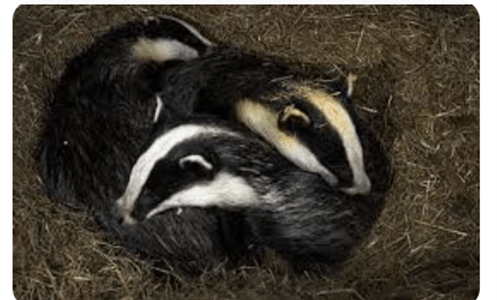
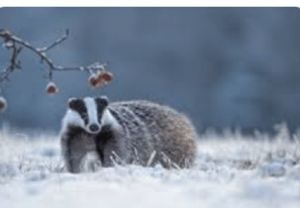
Through winter, badgers are a lot less active. Badgers do not truly hibernate, but may enter a state of torpor during freezing or snowy periods. During torpor, the badgers will remain in the sett, often for periods of several weeks, and metabolise fat reserves accumulated during the summer and autumn.
There is usually a marked decrease in a badger’s body temperature during the winter and early spring, being between 2C and 9C (3.6-16.2F) lower from November to April than it is from May onwards. This decrease in body temperature allows for greater “fuel economy,” prolonging their fat reserves when food is scarce or buried under snow.
During periods of exceptionally cold weather, badgers will often use a latrine inside the sett, rather than venturing outside. Though foraging activity fluctuates unpredictably during winter, badgers may forage, even in the snow.
Tag: Badgers
Badgers
A little intro to the European Badger……our black and white stripy friend.
| Life Span: | 5 – 7 years (typical in wild). Have been known to live up to 13 years. |
| Body Length: | 75cm (30″) head to tail. 90cm (35″) max. |
| Weight: | 10 – 12kg (22 – 26lbs) average. 23 – 27kg (51 – 60lbs) heaviest recorded. |
| Distribution: | Found throughout Europe with sub-species present in all continents except the Arctic and Antarctic. Particularly abundant in Britain and Ireland with the majority found in southern England. |

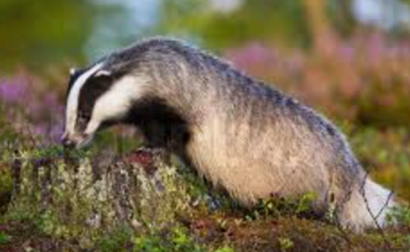
Badgers are stocky, short-legged animals that are easily recognisable by the black and white stripes that run from their nose to shoulders. They have small heads and eyes with a thick short neck and long wedge-shaped body that ends with a short tail.
Their powerful short legs end with paws, each having five digits, which are tipped with long, thick, sharp claws. This makes them very efficient diggers.
Black and white hair covers the badger’s body, making it appear grey from a distance. They have black chests and legs, a highly distinguishable black-and-white striped head with black ears that are tipped with white. Some badgers have different colour variations, such as ginger (erythristic) instead of black (melanistic). Also, some can be white (albino).
It’s difficult to tell male from female badgers. Males are slightly larger and heavier than females and normally have a wider head and a longer, thinner and lighter coloured tail.
Badgers are nocturnal animals that spend most of their lives underground in burrows called setts. They have highly social behaviour and live in family groups of up to 12 individuals. These groups display signs of hierarchy, with a dominant boar and sow leading the group.
Around dusk, they usually leave their setts to forage for food throughout the night until dawn, when they return to the safety of their sett.
Badgers can live in a wide range of habitats. Badgers mainly live on the edges of woodlands and pastures. They also live in scrubland, under hedgerows, in old quarries, on moorlands and open fields. Sometimes, they even live in gardens on housing estates.
The badger must select habitat offering plentiful food year-round. The site also must be secluded and well covered to allow inconspicuous emergence from setts. It also needs to be free from disturbance.
What are they up to this time of year…
Badgers have spent October fattening up for winter and, weather dependent, will continue this in November.
People may see increased activity in gardens where badgers visit and more snuffle holes in their lawns.
Badgers are omnivores. Their diet consists mainly of earthworms and grubs but can also include frogs, small mammals, birds, eggs, lizards, insects, plant bulbs, seeds and berries. They love peanuts and jam sandwiches as a treat.