
The Fearsome Australian Drop Bear

Caution: Drop Bears
Caution: Drop Bears

The Drop Bear (Thylarctos plummetus) is a large, arboreal marsupial native to the forests of Australia. A distant relative of the koala, it is described as a heavily built animal with powerful forearms for climbing. It is roughly the size of a large dog or leopard, with coarse mottled fur and a vicious bite.

Drop bears inhabit dense forests and tall woodland along Australia’s Great Dividing Range. From their elevated perches they wait silently in the thick canopy then drop onto unsuspecting prey walking below. The impact alone can stun a victim, allowing the drop bear to subdue it quickly with claws and teeth. The drop bear may haul the carcass up into the branches to finish eating it later.

Although drop bears prefer medium-sized mammals such as kangaroos or wallabies, bushwalkers are warned to remain alert beneath heavily wooded areas. Not only is the drop bear itself dangerous, but their food caches can fall and cause serious injury.

A variety of folk remedies can be used to prevent drop bear attacks. Vegemite behind the ears, forks worn in the hair, or adopting a convincing Australian accent are often recommended but none of these tactics have ever been scientifically proven.

In case you haven’t guessed, the Drop Bear is a cryptid. Australians tell the tale of the drop bear to tourists who are already a little spooked about Australian wildlife.
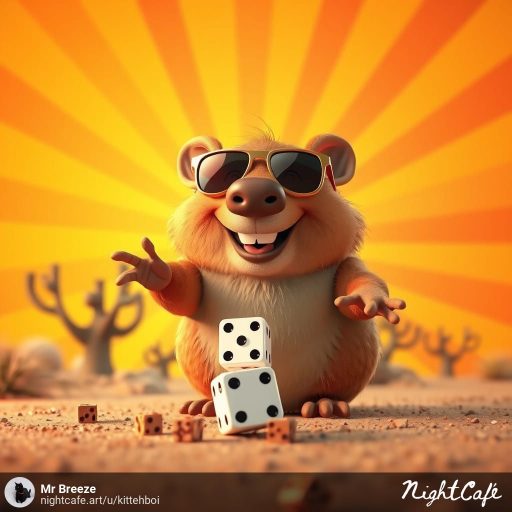
Shooting Craps: The Wombat

Wombat Shooting Craps
by @kittehboi and Nightcafe.

Wombats are cute little Australian animals. Their long teeth make them look like rodents, but in reality they’re marsupials, relatives of koalas and kangaroos.

Marsupials differ from mammals like dogs and cats in a number of ways, but the most important way is that wombat fetuses have a simple placenta that doesn’t provide enough nutrition for a large fetus. The joeys have to get out so early that they can’t live outside the mother’s body. After the joeys are born they have to make the arduous climb into their mama’s special pouch, where they will keep warm and drink milk until they’re big enough to live outside.

Wombat pouches are unique among marsupials. While kangaroo pouches open at the top, wombat pouches open at the bottom. Wombats like to dig. If they had a normal pouch, it would scoop up dirt.

According the the Department of Natural Resources and Environment Tasmania, bare-nosed wombats are about the size of a medium size dog.

Bare-nosed wombats average 1 m [39 inches] in length and 27 kg [50 pounds] in weight yet can reach up to 1.2 m [47 inches] in length and up to 35 kg [77 pounds] in weight. The Tasmanian wombat is not as large or bulky, averaging 85 cm [33 inches] in length and 20 kg [48 pounds] in weight, while the Flinders Island wombat is smaller still averaging only 75 cm [30 inches] in length.

Now about the dice.

Wombats have particularly long, flexible intestines. It takes up to 12 days for poop to traverse the wombat’s digestive tract, and it is wrung dry during the trip. The result is that wombat poop is unique: it’s cubic like dice. No other animal in the world poops dice!