Dancing in the Dark

Guest Post–Angel Alma

Friday the 16th of January was a special day in Lapland. For the first time in roughly six weeks, dawn broke. It peeked above the horizon at 12:02 p.m. and disappeared at 12:43 p.m. This happened in Utsjoki, in the northernmost part of Finland.

Winter nights are long in other parts of our country too. It’s not totally dark all the time, as the polar night season, which we call “kaamos,” is also bluish and in the south even light—during the few daylight hours.

This remarkable season offers moonlight, stars on clear nights, and the captivating auroras. Aurora Borealis, the northern lights, gives a display worth watching.

People in ancient times had various explanations for the magical glowing green, blue, yellow, and red lights which filled the sky, dancing, waving, and flickering.

Many folklore stories connect auroras with blood or dead human souls. People also saw them as signs of something big happening. In Finland they are called “Revontulet”, “repo” being an old name for a fox. “Tulet” means fires. So Firefoxes were running through the sky, swishing their tails, red sides touching trees and snow.

Scientists have been interested in auroras since early days, trying to explain their origin. Nowadays we know solar winds interacting with Earth’s magnetosphere cause them. Scientists still eagerly study them, and more secrets remain to be discovered.

No wonder auroras are one of the most admired tourist attractions in Lapland. Finland itself provides excellent observation locations, due to its northern location. It’s also more or less inhabited even in the remote areas. You can see auroras even in April, before it becomes too light.

Mun saw her first Auroras in Helsinki in the 1990s on New Year’s Eve. She went outside with friends during a party at midnight to wish each other a Happy New Year. Green lights were waving up in the sky, like silent fireworks.

For hunting Auroras, you have modern equipment to help. Just check one of the several Aurora alert apps on the phone or a meteorological site. Choose a wide, open place facing north, without too many city lights. Mum used to drive to the nearest fields, but lakesides are also good for spotting.

Aurora hunting is not always a success. Mum drove toward country regions for approximately thirty minutes during the nighttime, solely to observe stellar displays against the dark heavens. Driving back and going to sleep.

Sometimes Mum can see them behind the house, even from her bedroom window. If it’s too cold or too late, she stays in bed dreaming of firefoxes running over the dark winter sky, swishing their tails.

You can find more information about Auroras in Finland, for instance, on these internet sites:
Ursa Astronomical Association, Finnish Meteorological Institute, visitrovaniemi.fi and visitfinland.com 
Badgers–Scent Glands (Badger Article 2)

Badgers 2 article

Why you see a badger pop its bottom down on the ground…

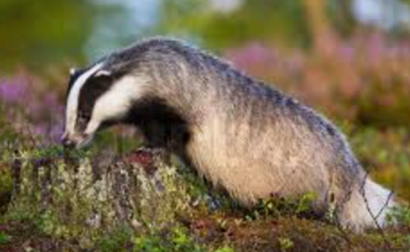
Scent plays a pivotal role in group and territory maintenance. Valuable tools in the act of scent-marking are the subcaudal gland (SCG), which is close to the anus, and the paired scent glands located just inside the anus—anecdotal observations suggest that scent glands between the toes (i.e. interdigital glands) may also be used when marking objects, such as trees, near the sett.

Arguably, the most important scent-marking tool is the subcaudal gland, which is used to mark objects in the territory and other members of the clan, which is a process known as allomarking.

The SCG comprises a pouch, the subcaudal pouch (SCP), that’s divided into two sections by a membrane. Several layers of sebaceous glands line the SCP, and these glands secrete an oily lubricant onto the skin and hair, as do apocrine gland cells. It opens to a horizontal slit, two to eight centimetres (about 1-3 in.) wide, between the base of the tail and the anus. The gland secretion is predominantly a composition of unsaturated fatty acids and water, with the consistency of a margarine-like paste. The bacteria partly generated the secretion’s odour in the pouch. Each fatty acid has its own characteristic smell. Chemical analysis of the SCP has shown that the bacterial component and fatty acid composition vary from badger to badger, suggesting each individual has its own unique scent.

What activity occupies them during this season?

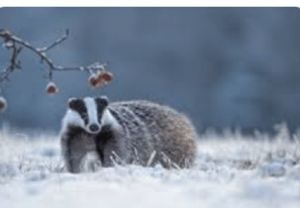
Through winter, badgers are a lot less active. Badgers do not truly hibernate, but may enter a state of torpor during freezing or snowy periods. During torpor, the badgers will remain in the sett, often for periods of several weeks, and metabolise fat reserves accumulated during the summer and autumn.

There is usually a marked decrease in a badger’s body temperature during the winter and early spring, being between 2C and 9C (3.6-16.2F) lower from November to April than it is from May onwards. This decrease in body temperature allows for greater “fuel economy,” prolonging their fat reserves when food is scarce or buried under snow. 

During periods of exceptionally cold weather, badgers will often use a latrine inside the sett, rather than venturing outside. Though foraging activity fluctuates unpredictably during winter, badgers may forage, even in the snow.

Badgers in Winter…(Badger Article 3)

Badgers article 3 Picture2

Badgers slow down so much that they can happily go into a deep sleep for days or even weeks during times of harsh weather. This sleep state, torpor, requires a significant sound for awakening, unlike hibernation’s deeper state.

Badgers build up reserves of fat during the autumn when there is plenty of food to eat. Fallen fruit, nuts, plus berries, combined with insects, worms, plus carrion, supply badger body fats to slumber for weeks, thus there’s zero worry for waking to eat. Badgers experience winter lethargy during this time period. As they rest, their bodies continue to function by using the energy in those fat reserves.

The UK experienced a mild autumn; thus, the badgers could fatten for winter. Our visiting badgers have been coming every night through December still. Following a dry summer, badgers require nourishment and hydration to survive the winter.

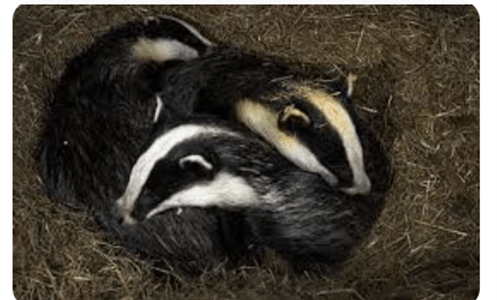
Whole family groups of badgers can make themselves comfortable deep underground in their sett, which provides shelter from rain and protection from extremely cold conditions. They collect bedding materials such as dry grass and fallen leaves to wrap themselves in.

During periods of exceptionally cold weather, badgers will often use a latrine inside the sett, rather than venturing outside. Foraging may occur even in snow, though winter activity fluctuates unpredictably.

Badger article 3 Picture3