Dancing in the Dark

Guest Post–Angel Alma

Friday the 16th of January was a special day in Lapland. For the first time in roughly six weeks, dawn broke. It peeked above the horizon at 12:02 p.m. and disappeared at 12:43 p.m. This happened in Utsjoki, in the northernmost part of Finland.

Winter nights are long in other parts of our country too. It’s not totally dark all the time, as the polar night season, which we call “kaamos,” is also bluish and in the south even light—during the few daylight hours.

This remarkable season offers moonlight, stars on clear nights, and the captivating auroras. Aurora Borealis, the northern lights, gives a display worth watching.

People in ancient times had various explanations for the magical glowing green, blue, yellow, and red lights which filled the sky, dancing, waving, and flickering.

Many folklore stories connect auroras with blood or dead human souls. People also saw them as signs of something big happening. In Finland they are called “Revontulet”, “repo” being an old name for a fox. “Tulet” means fires. So Firefoxes were running through the sky, swishing their tails, red sides touching trees and snow.

Scientists have been interested in auroras since early days, trying to explain their origin. Nowadays we know solar winds interacting with Earth’s magnetosphere cause them. Scientists still eagerly study them, and more secrets remain to be discovered.

No wonder auroras are one of the most admired tourist attractions in Lapland. Finland itself provides excellent observation locations, due to its northern location. It’s also more or less inhabited even in the remote areas. You can see auroras even in April, before it becomes too light.

Mun saw her first Auroras in Helsinki in the 1990s on New Year’s Eve. She went outside with friends during a party at midnight to wish each other a Happy New Year. Green lights were waving up in the sky, like silent fireworks.

For hunting Auroras, you have modern equipment to help. Just check one of the several Aurora alert apps on the phone or a meteorological site. Choose a wide, open place facing north, without too many city lights. Mum used to drive to the nearest fields, but lakesides are also good for spotting.

Aurora hunting is not always a success. Mum drove toward country regions for approximately thirty minutes during the nighttime, solely to observe stellar displays against the dark heavens. Driving back and going to sleep.

Sometimes Mum can see them behind the house, even from her bedroom window. If it’s too cold or too late, she stays in bed dreaming of firefoxes running over the dark winter sky, swishing their tails.

You can find more information about Auroras in Finland, for instance, on these internet sites:
Ursa Astronomical Association, Finnish Meteorological Institute, visitrovaniemi.fi and visitfinland.com 
Weather Article 1

Weather article 1 Picture1

#Weathercat:

My mummy and I both love the weather. She maintained a weather diary using paper for many years during her youth; now, our garden features a weather station we’ve had for quite some time. She finds it so interesting, exciting, and scary.

The UK’s weather feels the impact of its island status plus its geographical position. We are Atlantic driven but depending on the weather pattern setup and position of the jet stream, we can bring in weather from other directions.

Jet steam:

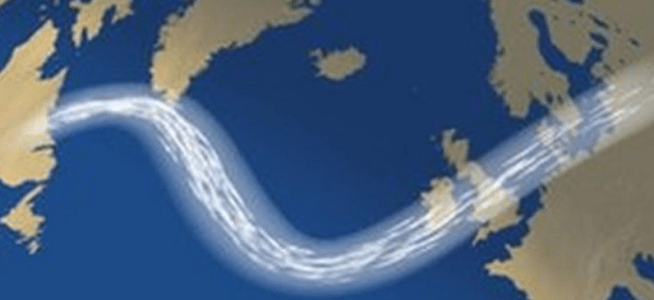
The jet stream is a high-altitude river of wind (5-7 miles up) that steers UK weather, blowing west-to-east, with its position dictating whether the UK gets mild, wet Atlantic weather (when it’s south of the UK) or colder, drier spells (when it’s further north). A fast, straight jet stream brings unsettled, stormy conditions by pulling low-pressure systems towards the UK, while a weaker, buckled jet stream can lead to blocked high-pressure systems, causing longer periods of stable, dry, or even cold weather, depending on the air masses involved. 

When we have a southerly wind in the summer, we have experienced dust storms up from the Sahara. A few years ago, when working in London, the entire city seemed to turn red and there was dust everywhere—it was quite an experience that Mummy loved.

If the winter weather pattern has high pressure blocking, we can then get the Beast from the East, which brings freezing temperatures and snow in from the East.

The cold spell we experienced over Christmas and the start of the year 2026 was driven from the North because of the position of the Scandinavian blocking high pressure. This cold spell has been across Europe, and Lapland has experienced record low temperatures of -42.8c.  Mummy has visited Lapland several times, and the lowest she has experienced is -30c and that was VERY cold.

Do you have a favourite weather? Our mummy’s is snow, she just loves it and finds falling snow and the sparkle and crunch of laying so super special. 

We will delve into some more weather facts and types of weather in future articles. 

Arctic Birds Migrating–A Spectacle to Enjoy

Guest Post–Angel Alma

Southeast Finland is ideally situated if you want to watch the arctic birds’ spring and especially autumn migration.

For instance, waders nesting in the North migrate in the springtime following the south coast of the country, but also those various species of geese.

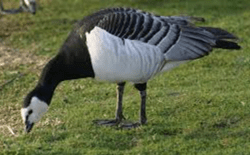
Perhaps the best-known migration show for common watchers, besides the “serious” birdwatchers, is the autumnal migration of Barnacle geese. Barnacle geese nest mostly around the Barents Sea, located north of the coasts of Norway and Russia.

They fly over Finland to their wintering areas around the North Sea. (Nowadays, Finland also has their own resident population, filling lawns in the parks of Helsinki, but that’s another story…).

However, in the last 20 years, more Barnacles started taking a stopover in SE Finland, to rest and eat before continuing their journey, usually in October. They changed habits a bit by surprise, landing in front of astonished humans.

Farmers weren’t, nor are joyful, using, for example, streamers, to frighten unwelcome visitors from fields. 

Earlier, it was popular for birdwatchers to travel to Northern Karelia near the eastern border, where you could watch migration from a high hill and cover even the Russian side near Lake Ladoga, if the birds took that route.

A small town near the border even organized special Geese Weeks, where they erected a big tent with a stove to grill sausages and keep warm. 

In October, the weather can be chilly, and as the Geese Migration needs a northern or northeastern wind, warm clothes are essential. Not to mention the sometimes hours of standing and waiting in wind and rain, watching the empty sky.

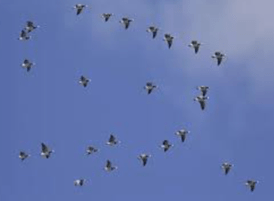
Mum has been there to see the phenomenon jokingly called “suffer birding”. However, when the crowd approaches from afar, soaring above your person while honking, one simply admires. Serious watchers, of course, count and mark the species in exact numbers. 

Nowadays, you can watch the fall migration more easily. Just walk outside, and if you are lucky, listen to the honking approaching. Observe the sky, and they approach! Or visit the nearby fields, where geese fill their tummies and gather strength. 

Then one day the wind turns and starts blowing from the right direction. Birds become restless, flying a bit there and back. Finally, the urge and instinct make them rise and drift into a formation. They fly higher and leave. Until next spring.