
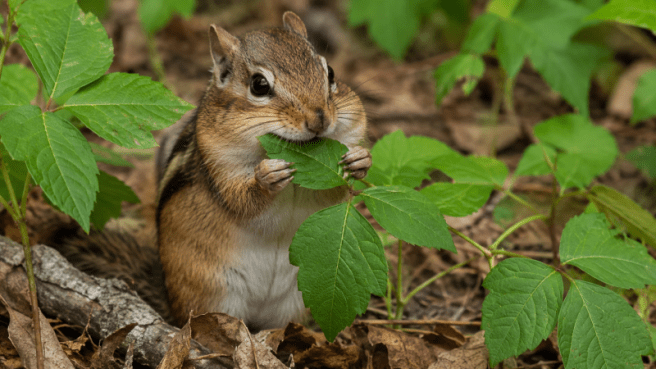
Animals don’t usually get poison ivy. However, the active ingredient, urushiol, is highly allergenic to most humans.
Non-primate species can roll in poison ivy and at most get some irritation. This means that cats and dogs can transfer the oil onto their humans without getting contact dermatitis themselves.
Mangoes, cashews and pistachios are popular foods that contain urushiol.
Mangoes: The oily skin, rind, tree sap, and leaves of the mango plant contain urushiol. Only the flesh is safe to eat. It’s not advisable to bite into an unpeeled mango.
Cashews: Raw cashew nut shells are coated in caustic oils similar to urushiol. This is why cashews are never sold in their shells. Cashews are a superfood and very popular in vegan recipes. They must be roasted to neutralize the toxin before you eat them. Unfortunately, the shells are removed by hand, and the workers get terrible burns.
Pistachios: Pistachio shells can contain trace amounts of urushiol, though usually not enough to trigger an allergic reaction.
Urushiol is not a universal poison. Different species tolerate it very differently. A chipmunk may eat poison ivy without a reaction, a cat may carry it home on its fur, and a human may break out in hives after an unnoticed contact. Nature sometimes spares the who walks in the leaves and punishes the person who pets it.
As an aside, this difference is Why Animal Testing is Illogical.



 The Anipal Times