Narrated by Iain Glen, this independent natural history documentary investigates the Scottish Wildcat, their endangered status and the conservation efforts being undertaken to prevent their extinction.
Scottish Wildcats are affectionately known as Highland Tigers. The name originates from their striped fur and that they’re not only one of Britain’s largest predators, but the UK’s only “big cat”.
Originally released on Netflix in 2018, this is the first time the full length, unedited version has been published, and in 4K.
Category: Trivial Purrsuit
Mr. Breeze
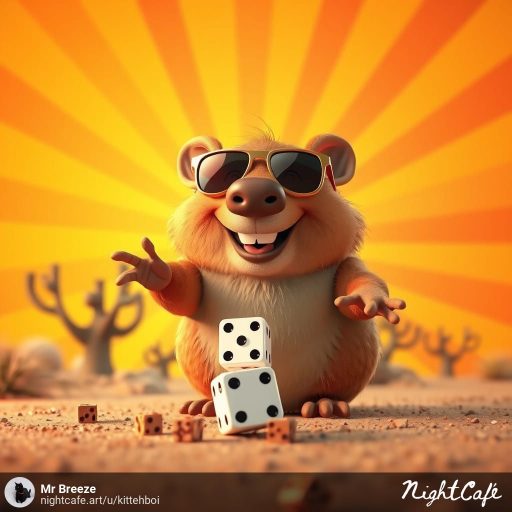
Shooting Craps: The Wombat

by @kittehboi and Nightcafe.
Wombats are cute little Australian animals. Their long teeth make them look like rodents, but in reality they’re marsupials, relatives of koalas and kangaroos.
Marsupials differ from mammals like dogs and cats in a number of ways, but the most important way is that wombat fetuses have a simple placenta that doesn’t provide enough nutrition for a large fetus. The joeys have to get out so early that they can’t live outside the mother’s body. After the joeys are born they have to make the arduous climb into their mama’s special pouch, where they will keep warm and drink milk until they’re big enough to live outside.
Wombat pouches are unique among marsupials. While kangaroo pouches open at the top, wombat pouches open at the bottom. Wombats like to dig. If they had a normal pouch, it would scoop up dirt.
According the the Department of Natural Resources and Environment Tasmania, bare-nosed wombats are about the size of a medium size dog.
Bare-nosed wombats average 1 m [39 inches] in length and 27 kg [50 pounds] in weight yet can reach up to 1.2 m [47 inches] in length and up to 35 kg [77 pounds] in weight. The Tasmanian wombat is not as large or bulky, averaging 85 cm [33 inches] in length and 20 kg [48 pounds] in weight, while the Flinders Island wombat is smaller still averaging only 75 cm [30 inches] in length.
Now about the dice.
Wombats have particularly long, flexible intestines. It takes up to 12 days for poop to traverse the wombat’s digestive tract, and it is wrung dry during the trip. The result is that wombat poop is unique: it’s cubic like dice. No other animal in the world poops dice!
Why Animal Testing is Illogical
Animal testing is illogical. Although humans and many other species have similar DNA, and though most organ systems are similar, subtle differences make using animal models to test food, drugs and cosmetics unreliable. Here are just three ways animals don’t react the same as humans.
Rats are known to be more resistant to a certain mushroom toxin than humans. Some mushrooms, notably the Fools webcap, contain a nephrotoxin called orellanine. Rats can eat mushrooms that are deadly to humans.
Feeding a food to animals is not a valid test.
In 2006 a new immune system boosting drug, TGN1412, which had been successfully tested in animals, went to human trials. The subjects were only given the equivalent of 1/500th the safe dose for “non-human primates,” macaques. A single amino acid difference between macaque and human DNA caused violent immune system reactions in humans. Within 90 minutes of the injection, the test subjects suffered searing pain. Within a few hours they suffered multiple organ failure. On a positive note, all the test subjects survived.
Giving a drug to animals is not a valid test.
Dogs and cats don’t usually get poison ivy. Most humans are highly allergic to the active ingredient, urushiol oil. Non-primate species can walk through poison ivy and at most get some irritation.
Applying cosmetics to an animal’s skin is not a valid test.
Fortunately, modern medicine has a number of alternatives to animal tests. One promising technology is Organ Chips, tiny devices about the size of a USB memory stick that contain living human cells.
Lots of drugs don’t make it through the animal trials, but who knows whether the drug companies have thrown away the Magic Bullet simply because it didn’t work on animals?
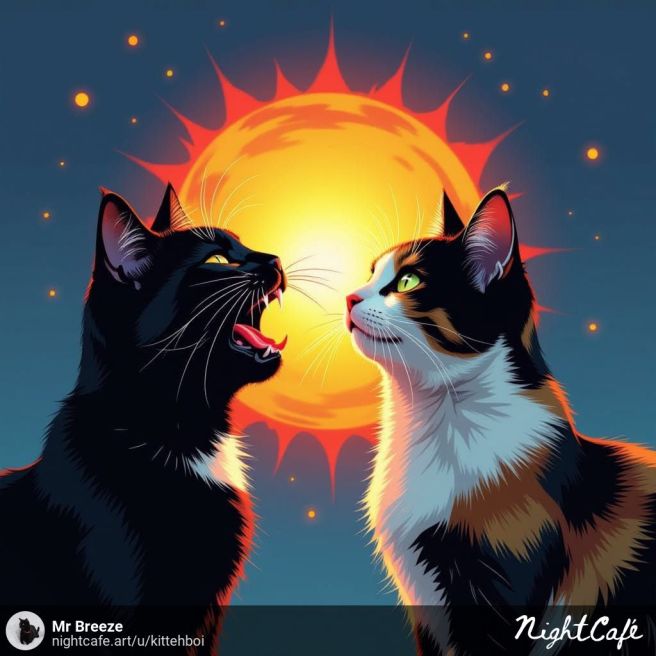
The Cat Who Ate the Sun

by @kittehboi & Nightcafe Studio.
“The Cat Who Ate the Sun” is a mythical story explaining the origin of tortoiseshell cats. According to the legend, the sun became a black cat to visit the Earth. When the sun left, it left behind its fire in the patches of red and orange in the torties’s coat.
This is why Tortoiseshell cats are so popular, because they seem to carry a spark of the sun itself.
Dogs Can Fly!
Did you know that rescue dogs in the UK were trained to fly a real airplane?
In 2016 Sky 1 aired a TV series called Dogs Might Fly. Twelve dogs underwent acting challenges, made music videos, and even acted in a live play.
Three of the dogs made it to flight school. With special equipment and training, the dogs learned to steer the plane, keep it level, and follow simple flying instructions. Two dogs were able to fly a Cessna 172 in a figure 8.
Good dogs!
The dogs didn’t handle takeoff or landing, but they did control the plane in the air. I think they earned their wings!
The Jersey Devil

Imagine if you will…
You are camping with your friends in the Pine Barrens of New Jersey. It’s an early fall evening. There’s a chill in the air and the moon is full.
As you sit around the campfire telling ghost stories, there is a sudden thrashing in the blueberry bushes. Something moves quickly toward your campsite. Wait, were those antlers? Is it a deer this late at night?
No, it is not a deer. It is South Jersey’s oldest cryptid, the Jersey Devil himself!
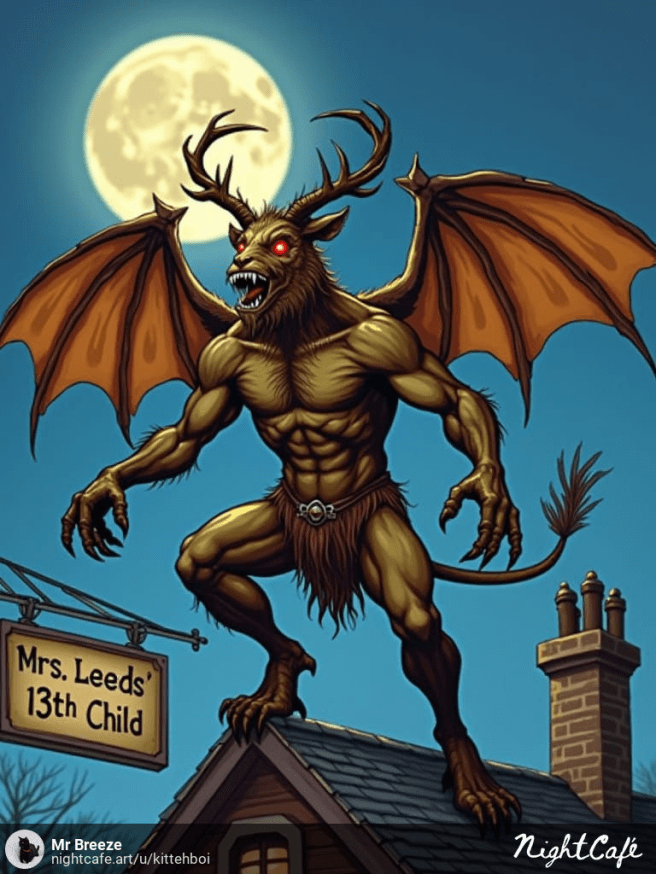
In 1735, decades before the Revolutionary War, Mrs. Leeds had her 13th child. As the boy was born, Mrs. Leeds cursed him. For a time, he seemed like a normal baby. Then one evening Mrs. Leeds entered the nursery to find her baby had grown hooves, wings, and vicious fangs. With a blood-curdling shriek he flew up the chimney and disappeared into the night!
The Jersey Devil has been sighted many times over the centuries, and he is responsible for many strange goings-on. Campers see glowing eyes in the brush. Children go missing, livestock is killed, and banshee-like wails are heard through the pines. He has even been seen on Long Beach Island cavorting with mermaids.
Today there is a little tavern on Leeds Point. The lights of Atlantic City are visible across the bay. And on stormy nights you may hear the Jersey Devil clip-clopping across the tavern roof.
Animals in Shakespeare

Did you know that William Shakespeare (April 1564 – April 23, 1616) was one of the first playwrights to write in English for regular people, rather than in French (the Lingua franca) or Latin?
Shakespeare wrote lots of animals into his plays. Here are just a few.
- “How sharper than a serpent’s tooth it is to have a thankless child” King Lear Act 1, Scene 4, 281–289
- “Let Hercules himself do what he may, The cat will mew and dog will have his day” Hamlet Act V, Scene I
- “Cry ‘Havoc’, and let slip the dogs of war” Julius Caesar (1599) Act III Scene I
- “By this reckoning he is more shrew than she.” Taming of the Shrew, Act IV, Scene 1
- “I am as vigilant as a cat to steal cream.” King Henry the Fourth, Act IV., Scene 2
- “Thou call’st me dog before thou hadst a cause, But since I am a dog, beware my fangs” The Merchant of Venice
If you haven’t read Shakespeare, download the totally free ebook at Project Gutenberg, The Complete Works of William Shakespeare.