The Cat Who Ate the Sun

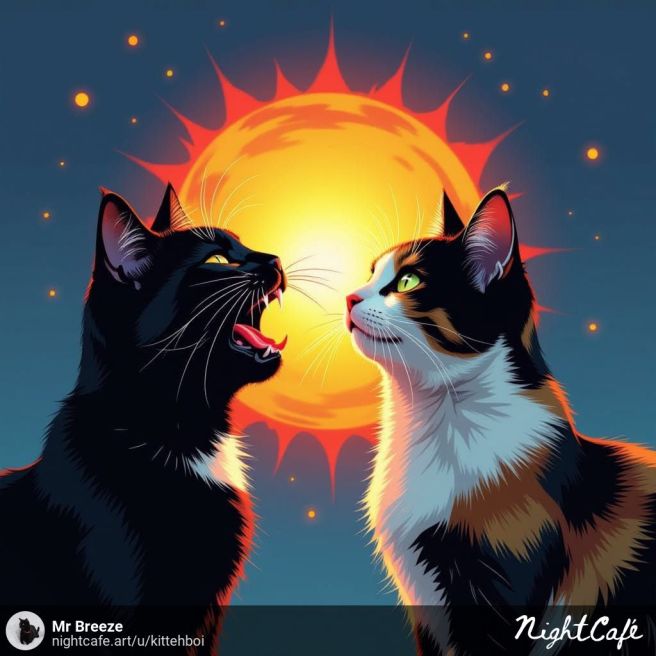
The Cat that ate the Sun
The Cat who ate the sun.
by @kittehboi & Nightcafe Studio.

“The Cat Who Ate the Sun” is a mythical story explaining the origin of tortoiseshell cats.  According to the legend, the sun became a black cat to visit the Earth. When the sun left, it left behind its fire in the patches of red and orange in the torties’s coat.

This is why Tortoiseshell cats are so popular, because they seem to carry a spark of the sun itself.

Where To Find Free! Ebooks

If you love to read ebooks, but your wallet is thin, there are many sites online for free ebooks. Here are just a few.

  • Your local library!
    Your local library’s web page probably includes eBooks and audiobooks to borrow. If you don’t have a library card, do get one! It’s free.
  • Project Gutenberg
    Project Gutenberg is an online library of over 70,000 free eBooks to download or read online. Much of the world’s great public domain literature is available. Many titles are also available as audiobooks.
  • The Internet Archive
    The Internet Archive offers over 20,000,000 freely downloadable ebooks. There is also a collection of 2.3 million modern eBooks that may be borrowed by anyone with a free Internet Archive account.
  • Open Library
    Open Library’s catalog provides links to discover, borrow, and read from the Internet Archive’s collections. Your Internet Archive account can be used to sign-in to Open Library.
  • Standard Ebooks
    Standard Ebooks provides beautifully-formatted editions of ebooks found in Project Gutenberg.
  • Ebooks.com
    400 of their most popular classics to read, free of charge.
  • For the Amazon Kindle:
  • You can, of course, borrow hardcopy from your local library.
    • Use InterLibrary Loan (ILL) to borrow books from other libraries. Ask the librarian.
    • OverDrive and WorldCat are both online catalogs to help you locate library books for ILL, including rare or unique hardcopy.

Do you have a favorite site for free ebooks or audiobooks not listed here? Please leave a comment.

Animals in Shakespeare

Did you know that William Shakespeare (April 1564 – April 23, 1616) was one of the first playwrights to write in English for regular people, rather than in French (the Lingua franca) or Latin? 

Shakespeare wrote lots of animals into his plays. Here are just a few.

  • “How sharper than a serpent’s tooth it is to have a thankless child” King Lear Act 1, Scene 4, 281–289
  • “Let Hercules himself do what he may, The cat will mew and dog will have his day” Hamlet Act V, Scene I
  • “Cry ‘Havoc’, and let slip the dogs of war” Julius Caesar (1599) Act III Scene I
  • “By this reckoning he is more shrew than she.” Taming of the Shrew, Act IV, Scene 1
  •  “I am as vigilant as a cat to steal cream.” King Henry the Fourth, Act IV., Scene 2
  • “Thou call’st me dog before thou hadst a cause, But since I am a dog, beware my fangs” The Merchant of Venice

If you haven’t read Shakespeare, download the totally free ebook at Project Gutenberg, The Complete Works of William Shakespeare.