

Shooting Craps: The Wombat

Wombat Shooting Craps
by @kittehboi and Nightcafe.

Wombats are cute little Australian animals. Their long teeth make them look like rodents, but in reality they’re marsupials, relatives of koalas and kangaroos.

Marsupials differ from mammals like dogs and cats in a number of ways, but the most important way is that wombat fetuses have a simple placenta that doesn’t provide enough nutrition for a large fetus. The joeys have to get out so early that they can’t live outside the mother’s body. After the joeys are born they have to make the arduous climb into their mama’s special pouch, where they will keep warm and drink milk until they’re big enough to live outside.

Wombat pouches are unique among marsupials. While kangaroo pouches open at the top, wombat pouches open at the bottom. Wombats like to dig. If they had a normal pouch, it would scoop up dirt.

According the the Department of Natural Resources and Environment Tasmania, bare-nosed wombats are about the size of a medium size dog.

Bare-nosed wombats average 1 m [39 inches] in length and 27 kg [50 pounds] in weight yet can reach up to 1.2 m [47 inches] in length and up to 35 kg [77 pounds] in weight. The Tasmanian wombat is not as large or bulky, averaging 85 cm [33 inches] in length and 20 kg [48 pounds] in weight, while the Flinders Island wombat is smaller still averaging only 75 cm [30 inches] in length.

Now about the dice.

Wombats have particularly long, flexible intestines. It takes up to 12 days for poop to traverse the wombat’s digestive tract, and it is wrung dry during the trip. The result is that wombat poop is unique: it’s cubic like dice. No other animal in the world poops dice!
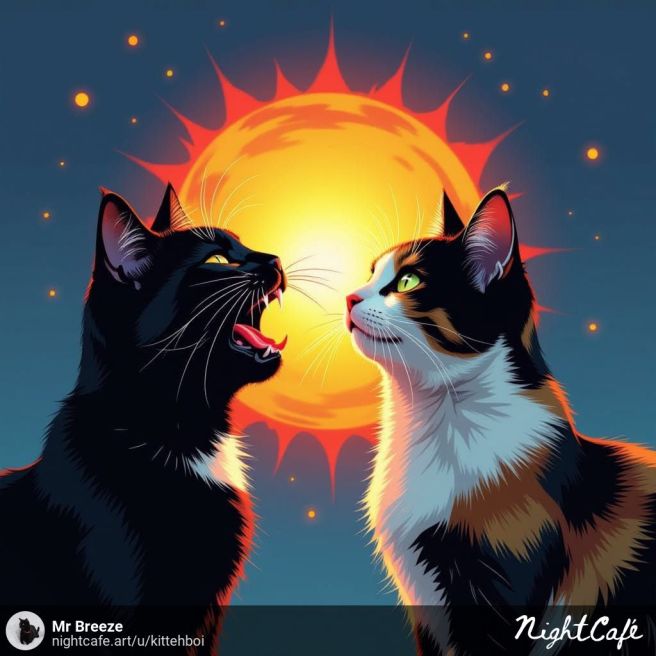

The Cat Who Ate the Sun

The Cat that ate the Sun
The Cat who ate the sun.
by @kittehboi & Nightcafe Studio.

“The Cat Who Ate the Sun” is a mythical story explaining the origin of tortoiseshell cats.  According to the legend, the sun became a black cat to visit the Earth. When the sun left, it left behind its fire in the patches of red and orange in the torties’s coat.

This is why Tortoiseshell cats are so popular, because they seem to carry a spark of the sun itself.

The Jersey Devil

The Jersey Devil
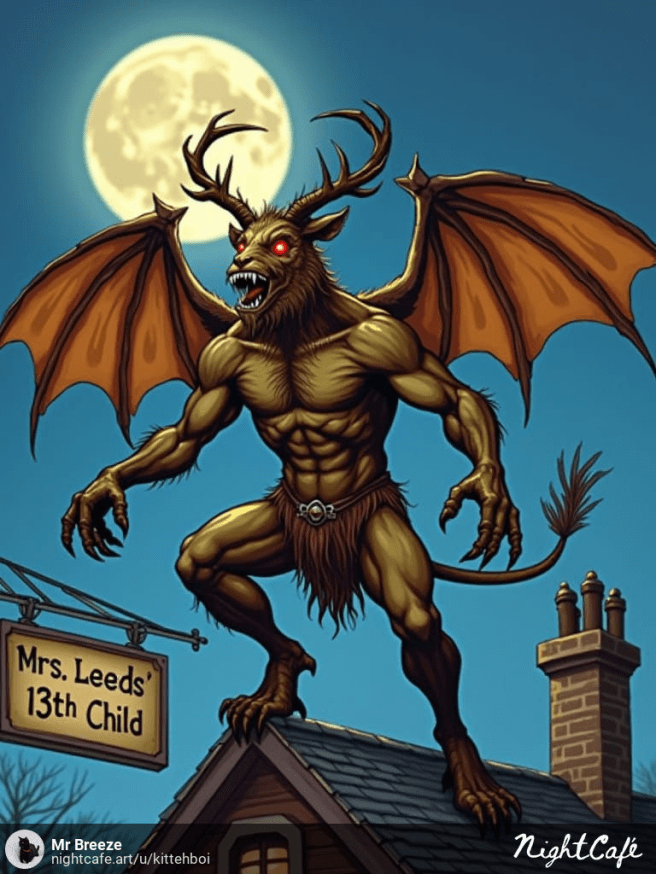
Mrs. Leeds’ 13th Child

Imagine if you will…

You are camping with your friends in the Pine Barrens of New Jersey. It’s an early fall evening. There’s a chill in the air and the moon is full.

As you sit around the campfire telling ghost stories, there is a sudden thrashing in the blueberry bushes. Something moves quickly toward your campsite. Wait, were those antlers? Is it a deer this late at night?

No, it is not a deer. It is South Jersey’s oldest cryptid, the Jersey Devil himself!


In 1735, decades before the Revolutionary War, Mrs. Leeds had her 13th child. As the boy was born, Mrs. Leeds cursed him. For a time, he seemed like a normal baby. Then one evening Mrs. Leeds entered the nursery to find her baby had grown hooves, wings, and vicious fangs. With a blood-curdling shriek he flew up the chimney and disappeared into the night!

The Jersey Devil has been sighted many times over the centuries, and he is responsible for many strange goings-on. Campers see glowing eyes in the brush. Children go missing, livestock is killed, and banshee-like wails are heard through the pines. He has even been seen on Long Beach Island cavorting with mermaids.

Today there is a little tavern on Leeds Point. The lights of Atlantic City are visible across the bay. And on stormy nights you may hear the Jersey Devil clip-clopping across the tavern roof.